

OUR SERVICES
Integrated Solutions
End-to-end production line — click on a station.
Heat Treatment
Heat treatment is one of the decisive steps in heavy welded fabrication: it relieves the residual stresses caused by welding, stabilises the geometry of the part and brings the welded structure to the condition required by the applicable design code.
Simgetek performs its heat treatment in its own facilities. Large and heavy parts therefore do not need to be shipped to outside heat treatment facilities, and the fabrication cycle stays under uninterrupted control from welding through to final machining.
Furnace Heat Treatment
- Post-weld heat treatment furnace: 16.5 m × 7.4 m × 7.2 m (L × H × W)
- Maximum temperature: 1,000 ºC
- Maximum part weight: 120 tons
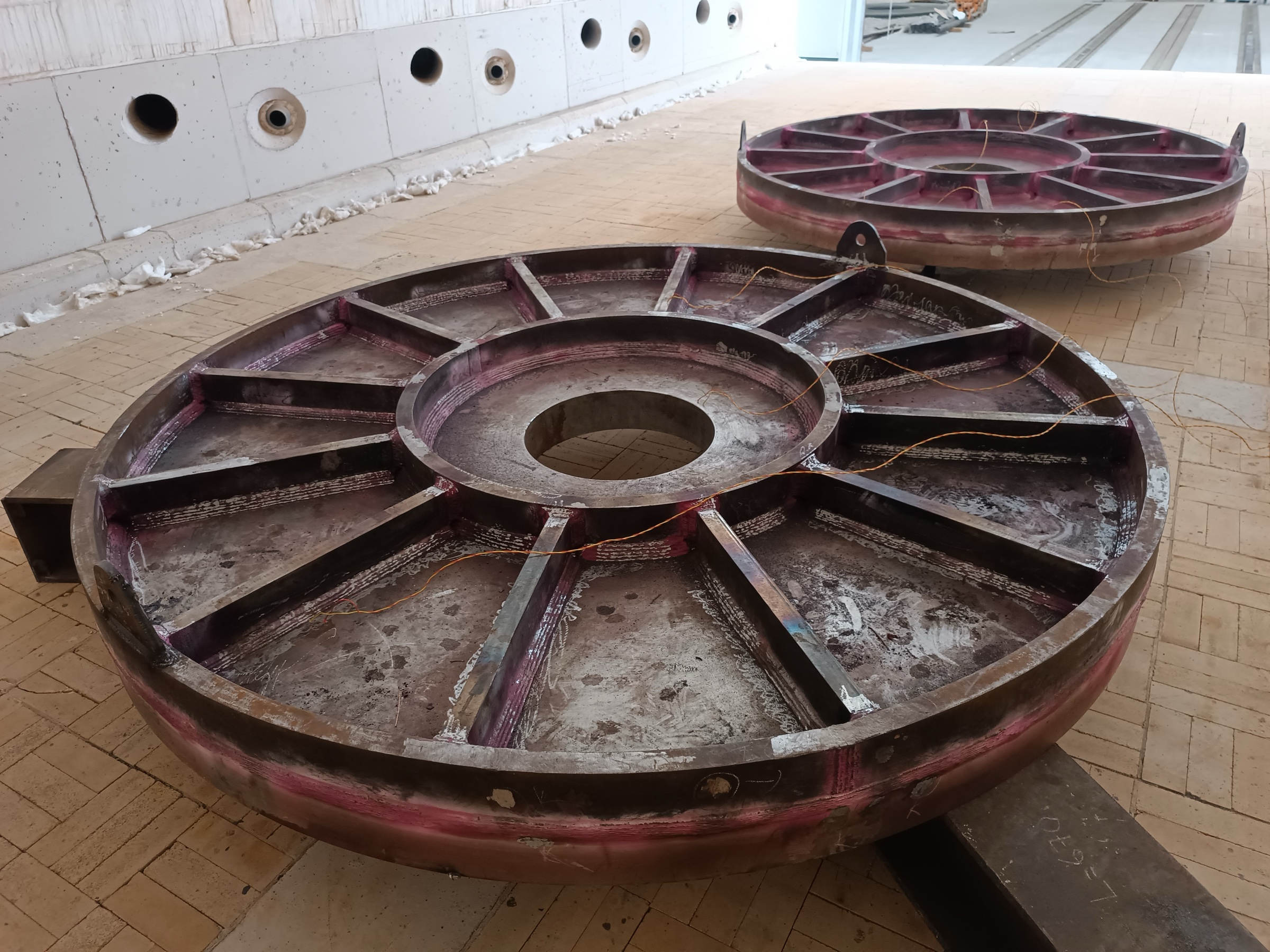
- Thermocouples: up to 48 thermocouples can be attached to the equipment
- Controlled cooling: cooling fans inside the furnace allow controlled cooling
- The furnace dimensions allow large vessels, columns, heat exchangers and heavy welded structures to be treated in one piece, so equipment does not have to be split for heat treatment alone.
Local Heat Treatment
Where furnace treatment cannot be applied — for example on site, on partially assembled equipment or for local weld repairs — heat treatment is carried out with portable equipment.
- Portable local PWHT machine for site and local applications
Process Control and Records
- Heating and cooling rates, holding temperature and holding time are set according to the applicable design code (e.g. ASME Sec. VIII Div. 1, UCS-56) and the qualified welding procedure
- Thermocouples are positioned according to the geometry and thickness of the part
- Temperature and time are recorded throughout the cycle
- Heat treatment charts are provided as part of the project quality dossier
Integrated with the Fabrication Sequence
- Heat treatment is planned as part of the production sequence, not as a separate service. This keeps the order of operations right:
- Welded fabrication and weld inspection
- Post-weld heat treatment
- Weld overlay on martensitic steel materials
- Stress relieving after overlay
- Final machining to the final dimensional and geometric tolerances
- Hydrostatic or pneumatic test
- Because welding, heat treatment and machining are carried out within the same organisation, dimensional changes caused by heat treatment can be anticipated in advance and compensated for at the machining stage.
Applications
- Following weld overlay applications
- Pressure vessels and columns
- Heat exchangers
- Special process equipment
- Heavy welded machine parts and structures
- Pipe spools and pipeline equipment such as pig launchers/receivers